Is this merchandise idea possible, and what would it cost?


Everything's possible. It just depends on how much you want to spend and how long you've got. Sometimes the honest answer is that it can be done, but at a price nobody will pay, so we'll suggest a way to get 90% of what you want for 10% of the price.
What should I send a merchandise supplier at the idea stage?
Less than you think. A typical first email from an agency says they're working on a project, may or may not say who it's for, and lists four, five, six or ten items they'd like prices and lead times on, with a date: "We need them by the 6th." Quantities and branding are often missing, and that's fine. More and more, there's an AI image too: "Ideally as close to the reference below as possible, but open to ideas."
Some briefs are just an idea from round a table: "Can you make a pen that lights up and plays a song when you click the top?" At that stage you want to know three things. Can it be made, can it be made in time, and does anything like it already exist?
We'll find out and come back with what's possible and what isn't. The pen might be possible, but only from 10,000 pieces at well over £50 each, the song you want might not be licensed, and the print area might be too small. So we'll suggest something that gives you the same effect: a water bottle, say, with a bigger branding area and room inside for a speaker, or a different material that works in smaller quantities. Most of the time the final item looks nothing like the first email. Not always, but usually.
How quickly can I get a ball-park price?
We usually get back to you within the hour, with an answer, a follow-up question or a request for more information. Better still, call at the idea stage: "Gary, we're thinking about a pink watermelon holder covered in fur. Is that possible?" I can usually give you an educated opinion there and then.
For a firm price:
A stock item, with all the information: within the hour, often faster. If it's urgent, ring and say so, and we can usually price it in 10 minutes, sometimes 5.
Something bespoke: within 24 hours, depending on how complicated it is. We'll keep you posted on what we're still waiting for. If a factory in China has closed for the day, we'll let you know, and you'll have an answer in the morning.
We keep the number of agencies we work with deliberately small, no more than ten at a time, so we have the resources to react straight away and give your project the attention it deserves.
How do you find out whether something can be made?
I've been doing this for almost 30 years. I started before Google and before AI, when the only way to find suppliers was to meet them at exhibitions around the world. That's how we built a network of factories that know what our clients need and how we work, and it's why we can get things that aren't offered as standard.
With a new factory or a new product, we inspect the factory, visit during production and check the goods before they leave. Whenever a product is new or bespoke, you get a pre-production sample to approve first.
Why does the price change after the first quote?
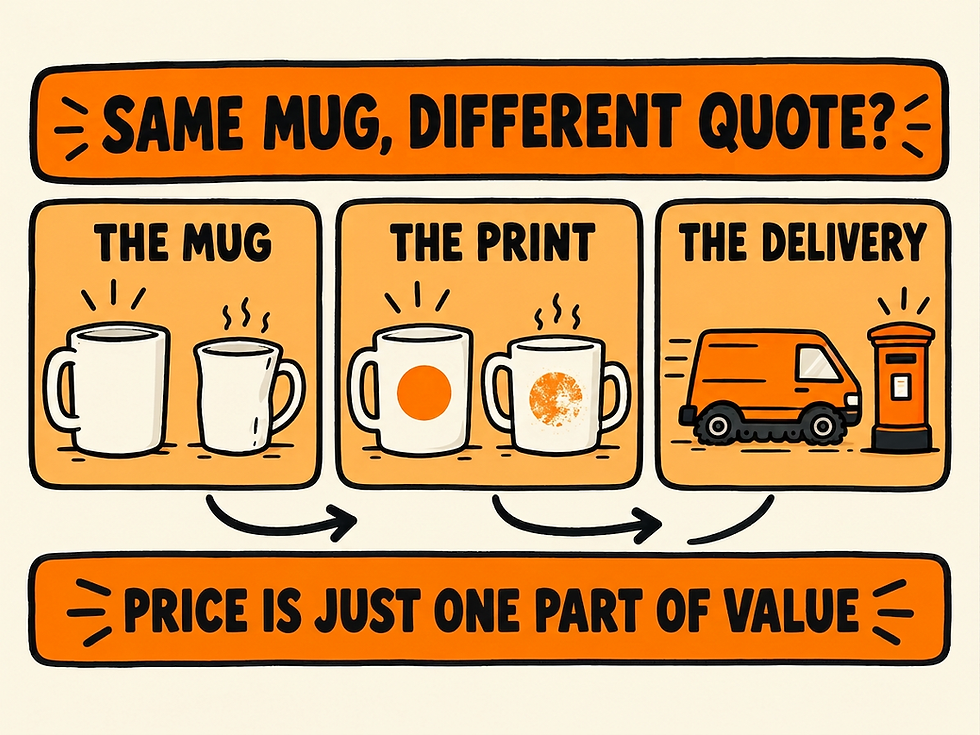
Only because the brief changes. If the client doesn't know how many they need, we'll quote for 1,000, 2,500 and 5,000 to give you a feel for it. A week later they want 25,000, or they love it but it costs more than they hoped, so could we quote for 250? The unit price drops a long way as the quantity goes up, and rises a long way as it comes down.
Branding works the same way. Without a logo, we'll quote one colour in one position. If it turns out to be three colours in two positions, the price changes, and you'll know why straight away.
What doesn't change is how we price. Our agencies have told us they prefer one price that includes moulds, set-up, delivery and pre-production samples, rather than a unit price with charges that turn up later. We also build in a little room, so if the brief moves slightly, from one colour to two, we can usually absorb it. You shouldn't have to go back to your client for more budget every time a detail changes.
What makes a merchandise idea not possible?
Usually budget, and we often see it before the agency does. Something we see all the time: "We want something really premium to give away at an event. It runs for 10 days and we need 1,000 a day." That's 10,000 items. At just £5 each, that's £50,000, and it's unlikely anyone will spend that on chocolates for an event. Sometimes we're wrong, but experience says it's improbable.
The other is time. If the event is a week away and nothing is agreed (no contract, no approved artwork, no product chosen), it takes at least two to four days just to get the order into production. If the event is abroad as well, sometimes we have to say it isn't feasible.
We can do a lot, but we can't turn back time. What we can do is suggest an express product we can turn round the same day or the next. A trolley coin or a T-shirt probably isn't what you wanted, but it can be delivered, and that beats losing three or four days on something that can't be done. It does need a decision straight away.
Why does the budget matter so much?
A real job. An agency brought us a brief for a holiday company with resorts all around the country: a box of games for each chalet, for the kids. Their visuals were beautiful. A fully bespoke, fully branded box of traditional games, every Jenga block engraved with the company's name, a colour-coded branded Twister.
We asked for a budget and were told there wasn't one, just make it as premium as possible. So we costed exactly what was in the visuals. Let's say it came to £100,000 (the figures here are for illustration). A couple of days later: that's far more than the client wants to spend, how can we save money?
You can always save money. Brand one Jenga block instead of all of them. Use an off-the-shelf box and brand the lid. We kept as much of the wow factor as we could, recosted, and it came back too expensive again. That went on for weeks. By the time it was down to what the client actually wanted to spend, it was so far from the box they'd fallen in love with that they decided not to go ahead.
It's like buying a car. Test drive the top of the range, then buy the cheapest model, and you'll be disappointed, because you're comparing it with the first car you drove. Tell the dealer your budget at the start, and you might test drive the one you can afford, love it and buy it. That's why we always ask for a budget, even when you'd rather not give one or don't have one yet.
What can I show my client before they commit?
If we've made something similar, or it's a standard product, we can often send a sample. For something completely bespoke, we'll show you the closest things we've made. Often that's a Zoom call: my office is full of past projects, so I can hold up a wooden box we made for another client and show you how it was branded, or the insert that held everything in place. We can also produce computer-generated visuals of the finished product, which AI is making more and more popular.
Does it cost anything to ask?
No. We don't charge for our time, whether the order goes ahead or not. As a rule, samples are free if the order goes ahead. If it doesn't, it depends on what the sample is worth and whether we've worked together before, and we'll agree that with you up front.
Before you send us your idea: a checklist
The first three are the holy trifecta. With them, we can get you the right ideas and the right products first time.
How many. A rough number or a range is fine.
How it will be branded. The logo, the number of colours and where it goes, if you know.
The budget. Even a ball-park figure, per item or in total.
The date you need them by, and where they're going.
A picture of what you have in mind. An AI image, a mood board or a photo of something similar.
Who it's for, if you can say: the event, the audience, or what the client wants people to do with it.
If you have none of that yet, call anyway.
Questions people also ask
Can a merchandise supplier work from an AI-generated image?
Yes. More and more briefs arrive with an AI image, and it's a useful starting point. Expect the finished product to be different, because an AI image doesn't know what can be made, what it costs or how long it takes. We'll tell you how close we can get within your budget.
Do merchandise suppliers charge for samples?
It varies between suppliers. We don't charge for our time, and as a rule samples are free if the order goes ahead. If it doesn't, it depends on the sample's value and whether we've worked together before, and we agree it up front.
How far ahead should I ask about merchandise for an event?
As early as you can, ideally while the idea is still being discussed. Even once everything is agreed, it takes at least two to four days just to get an order into production. A week before an event, especially one abroad, the choice is usually down to express products.
For more on pricing, see why the cheapest merchandise quote is not always the best value.
Who we are
GB Merchandise is a UK promotional merchandise supplier built for agencies, with offices in St Albans and Manchester. Gary Bucci founded it after working on the agency side and then for a merchandise distributor. The work agencies bring us is usually the work other suppliers won't touch: the bespoke product, the complicated brief, the order that has to land at fifty addresses. We do not invoice until the order has been delivered and you are happy with it. More on our About page, or call us on 0800 086 2552 (St Albans) or 0800 086 2554 (Manchester).